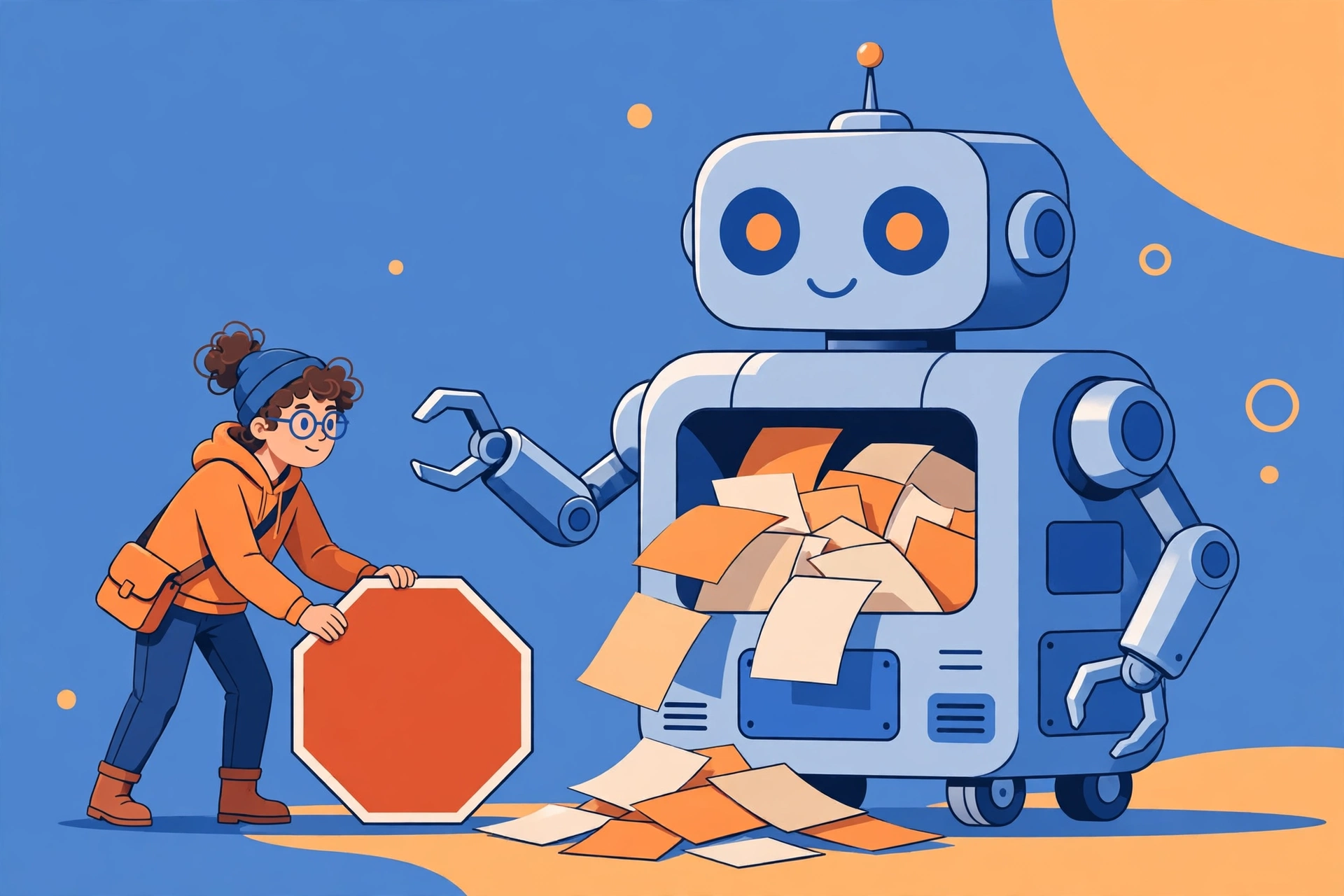
Ever felt your website’s content was used to train AI, but nobody ever really talked to you about it? Until now, if you wanted to opt out, you had to set up one rule at a time for each company. Starting in late October 2026, that story changes. OpenAI, Google, Microsoft, and Anthropic have agreed to use one shared signal.
This is not just technical news. For bloggers, media outlets, creators, and online shop owners, it is about control over their own work.
Quick summary
- OpenAI, Google, Microsoft, and Anthropic announced support for a single AI opt-out token on 30 October 2026.
- The token is called
__usage_ai-trainingand is written in therobots.txtfile. - Anthropic has already started applying it, OpenAI will follow in the coming months, Microsoft targets 1 February 2027, and Google targets 2027.
- The token only governs AI training, not whether your pages appear in Google Search or are cited in AI answers.
- It is still a draft and voluntary in nature, so it cannot yet be considered final legal protection.
What is new and why it matters
AI has long had a classic problem: every company has its own crawler names and rules. There is GPTBot from OpenAI, Google-Extended from Google, ClaudeBot from Anthropic, and Bing’s rules from Microsoft. Website owners had to memorise all of them, then write different rules for each.
The 30 October 2026 announcement cuts that complexity down to one shared preference. The four companies stated they will honour a single policy token in robots.txt that lets a website refuse the use of its content for AI training across all four companies at once.
Why does this matter? Because the debate over AI and copyright often feels lopsided. AI companies move fast, while small content owners have to chase each vendor’s documentation. One shared signal does not settle the whole debate, but at least it makes a website owner’s choice easier to read, easier to write, and easier to audit.
How it works, in plain language
Think of robots.txt as a notice board in front of your house. This text file is usually read by crawlers before they fetch pages, and its contents state how content may be used.
The new token is like adding one notice that four companies understand at once. For example:
User-Agent: __usage_ai-training
Disallow: /
Allow: /press-kit/
That means, in general, you do not allow your content to be used for AI training, except for the press kit folder. You can also flip it around, for example closing only some categories, or opening only specific pages.
There is one important detail that is often misunderstood. This token governs use for training, not whether a bot may visit your pages. The draft itself stresses that this policy token is not an instruction about crawling behaviour. So bots can still come for other purposes governed by separate rules, such as search indexing, unless you also block them through the usual crawler rules.
For Google, there is a fairly practical explanation. Google will interpret this shared token the same way as if you blocked Google-Extended, the crawler used for Gemini model training material, as long as you do not mention Google-Extended explicitly with a different rule.
The timeline is staggered, and that is important to note
Do not assume that the moment you write this token today, every company will comply tomorrow morning. The rollout is gradual. Anthropic has already started supporting the new directive, while Microsoft says it will start supporting it on 1 February 2027. Google says it will support it in early 2027, and OpenAI promises to apply it in the coming months.
So the most realistic step right now is: install the shared token now, but keep each company’s old rules in place until all of those implementation timelines have actually taken effect. OpenAI itself stresses that the new signal does not replace existing robots.txt controls.
What this token can and cannot do
What this token can do is state a preference to refuse AI training in one place for four large companies at once, set preferences per page path rather than only for the whole site, and reduce the risk of typos because you no longer have to memorise four different formats.
What this token cannot do is remove content that has already been collected or already used to train older models. If a page was crawled before, that company already has its content. This step only prevents future collection. This token also does not guarantee that every AI company in the world will comply, because it is a voluntary agreement among four companies, not a final standard binding on all parties. This token also does not by itself create a licensing or payment scheme, and it does not keep your pages out of AI answers that quote or fetch content directly when answering. That is a different area, called grounding or retrieval, and Microsoft is even preparing a separate grounding control apart from the training control.
Its legal status also deserves honesty. The document behind this announcement is an individual draft at the Internet Engineering Task Force (IETF) titled Machine-Readable Training Preference Signal, written by Kevin Kelley of Anthropic and dated 30 October 2026, valid until 3 May 2027. An individual draft like this has not received formal IETF support and has no formal standing in the IETF standards process. That means the draft’s contents may still change before it becomes a more official standard.
Meta is also worth noting. Meta is said to support the idea of a shared signal, but has not committed to implementing it. So do not assume every AI giant is on board.
Practical impact for users in Indonesia
For ordinary readers, this change may not be felt immediately. You can still use ChatGPT, Gemini, Claude, or Copilot as usual. The difference is behind the scenes: going forward, these companies have a tidier way to honour website owners’ choices.
For blog, media, and business website owners in Indonesia, the impact is more tangible. If you do not want your articles used to train AI models, you now have a simpler way to say so. If you actually want your content to be easily found and cited by AI, do not block everything indiscriminately. There is a trade-off to think about. Google says sites that explicitly allow Google-Extended still stand a chance to appear and earn clicks through grounding in Gemini Apps. If your website relies on search traffic, rest easy for now. This training token is not the same as blocking Google Search. But still double-check your robots.txt rules, because a single wrong line can have a wider impact than you might think.
On cost, there is no price to pay just to write this token in robots.txt. It is a setting on the website side, not a paid product. What needs investing is time to check, test, and monitor whether your rules are correct.
Balanced pros and cons
The advantages are clear: simpler, more consistent, and friendlier for small website owners who do not have a large legal or technical team. The disadvantages are equally clear: still a draft, still voluntary, staggered timelines, not retroactive, and not yet covering every company. This is a step forward, not the finish line.
Who this suits, and who it does not yet suit
It suits you if you own a blog, media outlet, portfolio, or business website and want to keep control over your original content, are tired of managing different crawler rules for each company, and want to take a firm stance on AI training while still appearing in search.
It is not enough as your only safeguard if you expect strong legal protection enforceable against all parties, hope that old content already used can be pulled back just by changing robots.txt, or want to block all forms of AI use including AI answers that quote your pages directly. For that, you need to understand the separate grounding control.
Final verdict
This is good news that deserves a cool head. For the first time, the four largest AI labs have agreed to read one shared language on training preferences. That is real progress for content owners. But do not rush to consider the matter closed. While this token is still a draft, still voluntary, and its timelines still stretch into 2027, a website owner’s job has not changed: set the rules correctly, keep the old rules as a safety net, and keep following developments.
If you own a website, the most practical advice is simple: check your robots.txt this week. Decide consciously whether to open, partially close, or fully close it to AI training. Because from now on, that choice can finally be written in a single line understood by many companies at once.
Quick Q&A
Does this token block Google Search? No. This token governs AI training, not search indexing, as long as your search crawler rules are not changed as well.
Can old content be pulled back? Not with this token alone. This token only applies to future collection, not to content already gathered or already trained on.
When will all companies comply? Anthropic has started, OpenAI in the coming months, Microsoft on 1 February 2027, and Google in 2027.
Sources
- Engadget, Google Joins OpenAI And Anthropic In Promising New Scraping Controls
- AI Weekly, OpenAI, Google, Microsoft, Anthropic Back One AI Opt-Out Token
- The Brief, Four AI Companies Agree on a Shared Opt-Out Signal for Web Scraping
- Unite.ai, OpenAI to Honor Shared Robots.txt Signal for AI Training Preferences
The main illustration in this article is a generated illustration, not an actual photo of a product or company. This article was written on 1 November 2026 based on the 30 October 2026 announcement, so each company’s implementation timeline may still change.
